September 8, 2026
No Comments
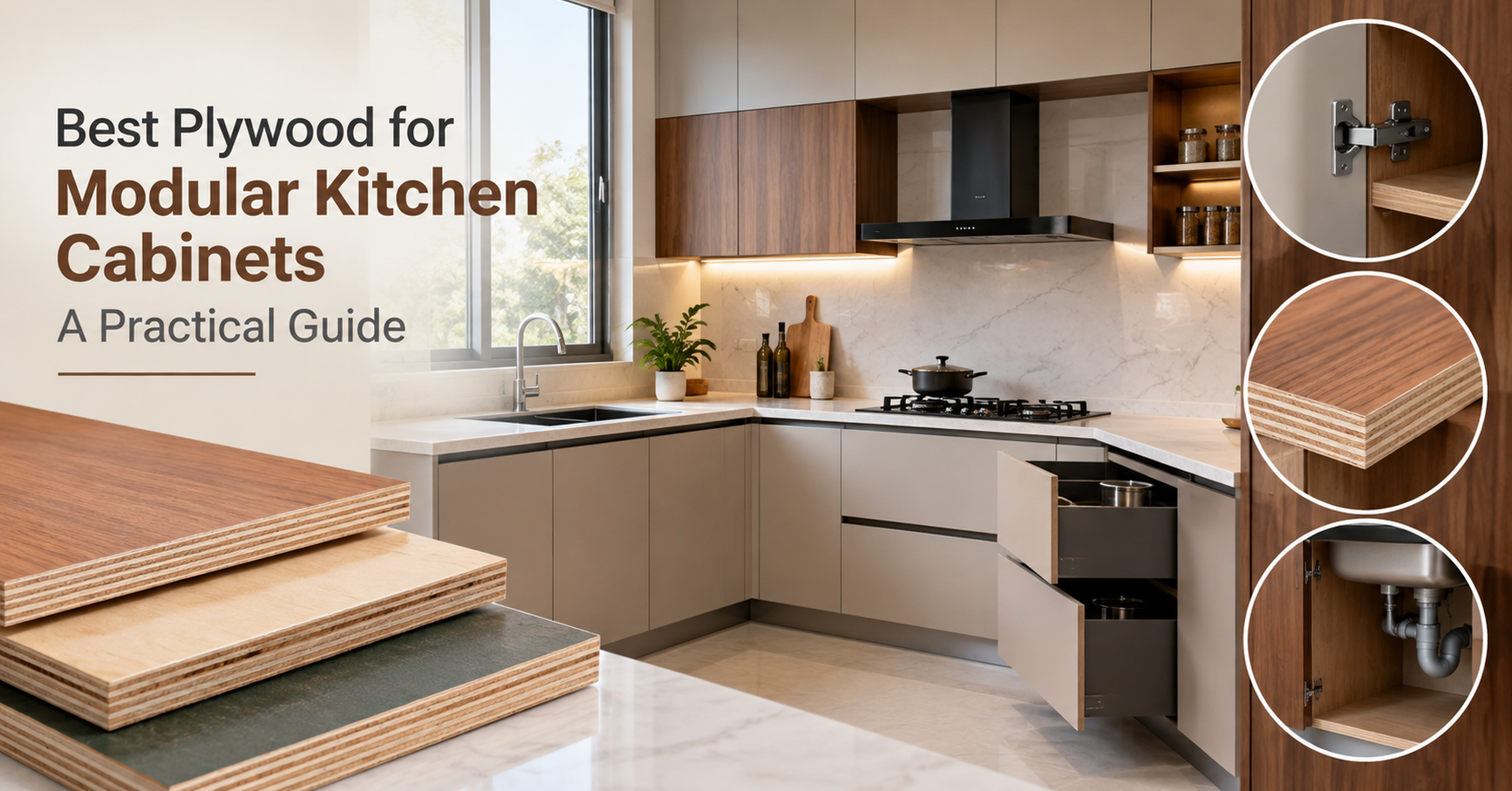
Best Plywood for Modular Kitchen Cabinets: A Practical Guide
A modular kitchen looks the same on installation day whether it’s built with good plywood or bad plywood. The difference shows up later — in a shelf that sags under a pressure cooker, a shutter that stops closing flush, or a sink cabinet base that starts to swell.
Kitchen cabinets face more daily stress than almost any other furniture in the house: constant humidity, spills, heat, and hundreds of open-close cycles. Choosing the best plywood for a modular kitchen decides whether it still works properly in five years or needs replacing in two. This guide focuses only on that decision — grade, thickness and placement — not kitchen layouts or design trends.
Table of Contents
What Makes Plywood Suitable for a Kitchen?
Look for six things: moisture resistance (steam and spills are daily, not occasional), screw-holding strength (hinges and channels get handled constantly), resistance to warping (shelves and tall panels must stay flat under load), durability under repeated shutter/drawer use, surface quality (affects how well laminate bonds), and long-term maintenance tolerance.
Which Plywood Grade Is Best?
| Grade | Moisture Resistance | Best Used For | Limitation |
|---|---|---|---|
| Commercial / plain | Low | Not recommended for kitchens | Fails under steam and spills |
| MR (Moisture Resistant) | Low–Moderate | Upper cabinets away from water, if budget-tight | Not built for prolonged moisture |
| BWR (Boiling Water Resistant) | Good | Most of the kitchen — general cabinets, shutters, shelves | Not meant for standing water |
| BWP / Marine Grade | Very High | Sink cabinet, high-splash zones | Costs more than BWR |
Rule of thumb: use BWR for most of the kitchen, and reserve BWP only for the sink cabinet and any area with frequent water contact. This keeps cost reasonable without compromising the highest-risk zone.
BWP vs BWR for Kitchen Cabinets
BWR (phenolic-bonded) resists steam and short-term splashes well, making it the practical default for wall cabinets, tall units, and general base cabinets. BWP (marine-grade) is tested for prolonged water exposure and is the safer choice specifically where leaks or standing water are realistic — above all, under the sink.
For the underlying grade differences in more depth, see our BWP vs BWR Plywood for Bathrooms guide — the same principles apply in a kitchen.
What Thickness Should You Use?
There’s no single correct thickness for every kitchen — it depends on span, load and hardware. Commonly used ranges: carcass 18–19mm, shutters 16–19mm, shelves 12–18mm (longer spans need more), drawers 12–16mm, back panels 6–8mm. Confirm the exact thickness for your cabinet dimensions with your supplier or carpenter rather than assuming one size fits all.
Plywood by Kitchen Component
| Component | Recommended Grade | Why |
|---|---|---|
| Sink cabinet | BWP / Marine | Highest exposure to leaks and standing water |
| Base cabinets (general) | BWR | Regular spills, not constant water |
| Wall cabinets | BWR (or MR if truly away from steam) | Lower exposure than base units |
| Tall units | BWR | Structural load matters due to height |
| Shelves & shutters | BWR | Frequent handling, occasional spills |
| Drawers | BWR (BWP if near the sink) | Daily use, occasional splashes |
Using BWP throughout is also valid if budget allows — it’s simply the more conservative, costlier option.
What “Waterproof” Actually Means
In India, plywood grades link to IS standards: commercial and MR generally fall under IS 303, while BWP/marine plywood is tested to the stricter IS 710 boiling-water standard. BWR resists steam and short exposure; BWP is built for prolonged or repeated contact. Even BWP isn’t a reason to ignore basic care — wipe up standing water and fix leaks promptly regardless of grade.
Buying Checklist
- Confirm the grade explicitly — commercial, MR, BWR or BWP — don’t assume from appearance.
- Match thickness to component rather than using one thickness throughout.
- Check the core for voids or uneven layers at the cut edge.
- Check surface smoothness — affects laminate/paint adhesion and longevity.
- Check bonding at edges and corners for any separation.
- Ask about certification (IS 303 / IS 710) and any manufacturer warranty.
- Buy from a credible supplier — mislabelled grades are a common market problem; ask to see the actual board.
Common mistake to avoid: using MR or commercial-grade plywood near the sink to save cost — this is one of the most frequent causes of early cabinet failure.
What Does Kitchen Plywood Cost?
Pricing depends on grade, thickness, brand, sheet size and current market rates — enough factors that a single fixed figure wouldn’t be accurate here. The most reliable way to get a real cost is to share your cabinet dimensions and grade preference with a supplier directly. If you’re in Faridabad or the NCR region, our team at Gupta Timber Company can talk you through current BWR and BWP options in person.
FAQs
- Which plywood is best for a modular kitchen?
BWR for most of the kitchen; BWP/marine grade for the sink cabinet specifically. - Is BWP better than BWR for kitchen cabinets?
BWP resists water for longer, making it the safer choice near the sink. BWR is generally adequate — and more cost-effective — everywhere else. - What thickness plywood is best for kitchen cabinets?
Commonly 18–19mm for the carcass, with thinner boards for shelves, shutters and drawers depending on span and load — confirm against your actual cabinet design. - Is waterproof plywood necessary for every cabinet?
Not usually. Most kitchens use BWP only where water exposure is highest and BWR elsewhere, balancing durability and cost. - How long does kitchen plywood last?
Correctly graded, well-installed and reasonably maintained BWR/BWP boards are built to hold up for years, though exact lifespan depends on usage and upkeep.
Conclusion
The design gets the attention during kitchen planning, but the plywood underneath decides whether it still looks and works well years later. Get the grade right per section — BWR for most of it, BWP where water risk is highest — and confirm thickness against your actual cabinet dimensions.
Visit Gupta Timber Company’s Plywood & Boards range to see available BWR and BWP options, or get in touch for guidance specific to your kitchen.