September 24, 2026
No Comments
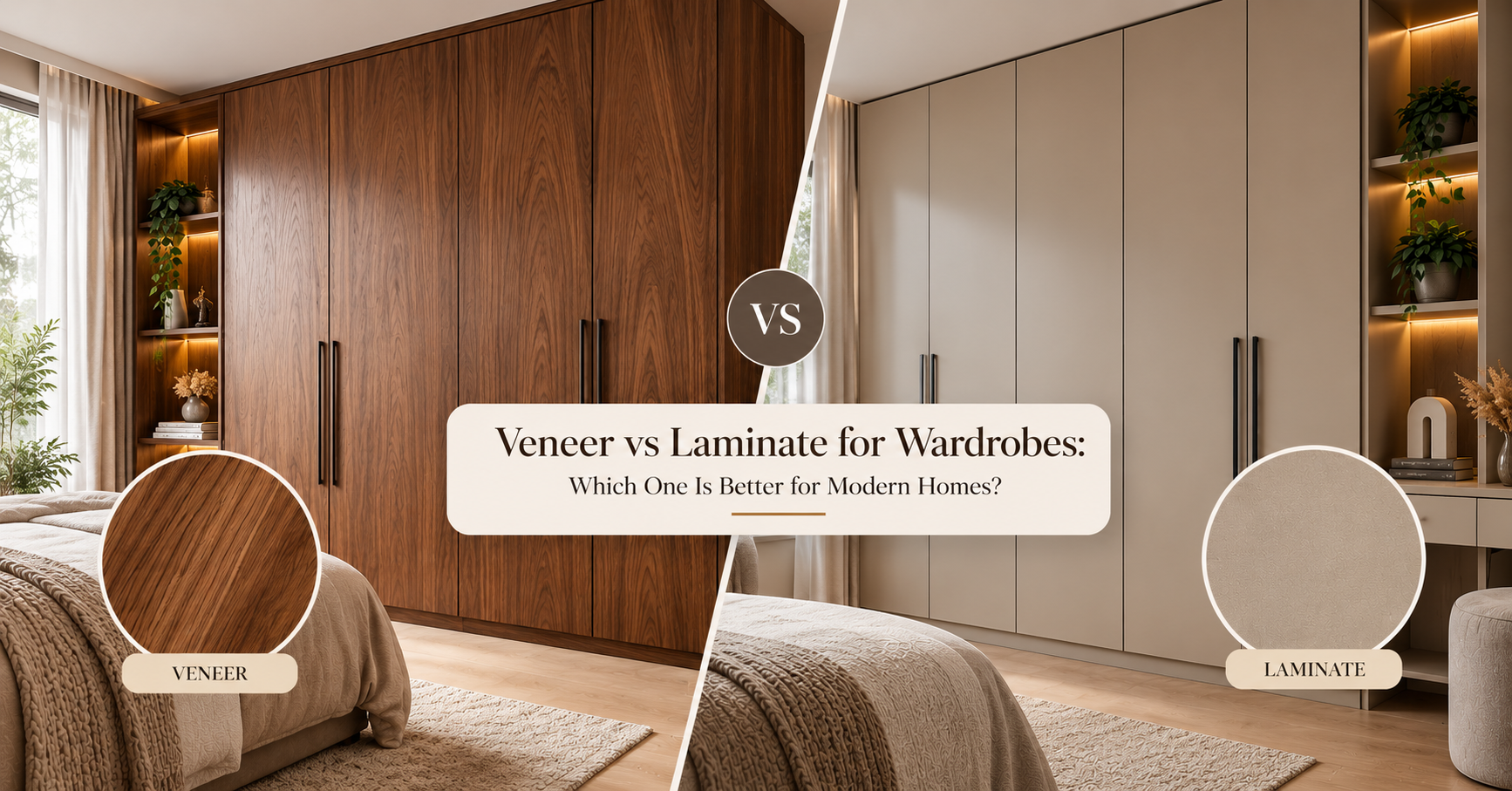
Veneer vs Laminate for Wardrobes: Which One Is Better for Modern Homes?
Picking a wardrobe design is usually the easy part — most people already have a rough idea of the layout and shutters. The harder decision comes when the carpenter asks what finish you want: veneer or laminate.
The plywood underneath matters for strength, but the surface finish is what you actually see and touch every day. It affects how the wardrobe looks, how easy it is to clean, and how it holds up over years of use. Veneer and laminate are the two most common finishing options for wardrobes in Indian homes, and each has a genuinely different look and feel — here’s how they compare.
Table Of Contents
- What Is Veneer for Wardrobes?
- What Is Laminate for Wardrobes?
- Veneer vs Laminate for Wardrobes: Key Differences
- Veneer – Advantages and Disadvantages
- Laminate – Advantages and Disadvantages
- Which Is Better for Modern Wardrobes?
- Veneer vs Laminate for Wardrobe Cost
- Can Veneer or Laminate Be Applied on Plywood?
- How to Choose the Right Wardrobe Finish
- Popular Wardrobe Finish Ideas for Modern Homes
- Where to Buy Veneer and Laminate in Faridabad?
- Frequently Asked Questions
- Conclusion
What Is Veneer for Wardrobes?
Veneer is a thin slice of real wood, cut from a log and bonded onto a base board like plywood. Because it’s genuine wood, it carries a natural grain pattern and colour variation that’s hard to replicate artificially — no two sheets look exactly alike, which is part of the appeal for anyone wanting a more organic, premium look.
Veneer is usually finished with polish or lacquer after application, which brings out the grain and adds protection. It works well for wardrobe shutters and feature panels where the natural wood look is the main goal.
What Is Laminate for Wardrobes?
Laminate is a manufactured sheet, typically layers of paper or fibre bonded with resin under heat and pressure, finished with a printed or textured top layer. It doesn’t rely on real wood — it can mimic wood grain, or come in solid colours, patterns, and textures like matte, gloss, or suede.
Laminate is applied onto plywood or board in a similar way to veneer, but since the surface layer is manufactured, the finish is far more consistent from sheet to sheet. That consistency, plus the huge design range, is why laminate for wardrobes is so widely used.
Veneer vs Laminate for Wardrobes: Key Differences
| Factor | Veneer | Laminate |
|---|---|---|
| Appearance | Natural wood grain, unique per sheet | Consistent, wide range of printed/textured designs |
| Material | Real wood slice on a base board | Manufactured resin-bonded sheet |
| Design Options | Limited to natural wood tones | Extensive — colours, patterns, textures, woodgrain prints |
| Durability | Good with proper coating and care | Generally durable, resists daily wear well |
| Scratch Resistance | Moderate, depends on coating | Generally good, varies by quality |
| Moisture Resistance | Needs proper sealing; more sensitive | Generally more moisture-tolerant on the surface |
| Maintenance | Periodic polishing/care | Low maintenance, wipes clean easily |
| Repairability | Can sometimes be refinished | Damaged sections harder to repair invisibly |
| Cost | Varies more, often positioned higher | Wide range, generally more budget-flexible |
Actual performance depends on the specific product and application quality, so it’s worth checking samples in person.
Veneer – Advantages and Disadvantages
Advantages: genuine natural wood appearance, unique grain on every panel, a warmer premium look, and sometimes refinishable depending on application.
Limitations: needs appropriate care and occasional maintenance, natural variation means panels won’t look identical, finish quality depends heavily on application, and cost can vary by wood type and grade.
Laminate – Advantages and Disadvantages
Advantages: wide range of colours, patterns and textures, easy to wipe clean, consistent appearance across panels, and available in matte, gloss, woodgrain and textured finishes.
Limitations: doesn’t replicate the depth of real wood, damaged edges can be hard to repair invisibly, and quality varies noticeably between products.
Which Is Better for Modern Wardrobes?
There’s no universal answer — it depends on what you’re looking for.
Veneer may suit you if you want a natural wood appearance, visible grain character, and a warmer interior aesthetic, and you’re comfortable with some upkeep.
Laminate may suit you if you want more design flexibility, easier daily cleaning, consistent colours across every panel, and a practical, low-maintenance finish.
Your home’s design language, budget, how the wardrobe will actually be used, and how much maintenance you’re willing to do all matter more than any single “better” option.
Veneer vs Laminate for Wardrobe Cost
Several factors influence what you’ll pay, regardless of finish: material quality, thickness, brand, finish/design complexity, application labour, the base board underneath, and the overall wardrobe size. Wardrobe laminate sheet price varies enough across these factors that it’s best to get a quote for your specific wardrobe rather than relying on a general figure.
Can Veneer or Laminate Be Applied on Plywood?
Yes — both are surface finishes applied over a base board, and plywood is one of the most common choices for that base. The plywood (or block board) provides structural strength, while the veneer or laminate on top is purely the visible finish. The same plywood base can be finished with either option — the decision is about the surface look you want, not the base material underneath.
How to Choose the Right Wardrobe Finish
Think through: your interior style (natural/warm vs clean/modern), budget for the finish specifically, how much maintenance you’re comfortable with, how heavily the wardrobe will be used, the appearance you want, whether the space sees moisture, and whether you prefer identical panels or natural variation.
Popular Wardrobe Finish Ideas for Modern Homes
Natural wood-look veneer for a warm, organic feel; matte laminates for a clean modern look that hides fingerprints; woodgrain laminates for the wood aesthetic without veneer’s upkeep; textured laminates for tactile depth without shine; and neutral colours or low-contrast finishes for a spacious, minimal feel. Laminate sheets designs today cover a wide enough range that most interior styles have a reasonable match.
Where to Buy Veneer and Laminate in Faridabad?
If you’re comparing veneer and laminate for a wardrobe project, Gupta Timber Company is a Faridabad-based trader and supplier of laminates, veneers, plywood, timber, block boards, doors, and decorative panels. Many customers search for laminate sheets near me when they want to see finishes in person rather than choosing from a catalogue alone, and we keep a range of laminate sheets and veneer options ready to compare side by side. If you’re still deciding on the best laminate for interior design that suits your home, our team can walk you through the options based on your wardrobe and overall interior style. We also supply the plywood typically used as the base material, so both the structure and the finish can be sourced from one place.
Frequently Asked Questions
- Is veneer better than laminate for wardrobes?
Neither is universally better — veneer offers a natural wood look with some maintenance, while laminate offers more design variety and easier upkeep. - Is laminate cheaper than veneer?
Laminate generally offers more budget flexibility, though pricing for both varies by quality and brand — best to compare actual quotes. - Which is easier to maintain?
Laminate is generally easier day-to-day, needing just a wipe-down, while veneer may need occasional polishing. - Is veneer durable for wardrobes?
Yes, with proper coating and reasonable care, though it’s more sensitive to moisture and scratches than most laminates. - Can laminate be applied over plywood?
Yes, laminate is commonly applied over plywood, which provides the structural base while the laminate serves as the finish. - Which finish looks more natural?
Veneer, since it’s genuine wood with unique grain. Woodgrain laminates come close visually but lack the exact depth of real wood. - Which laminate is suitable for wardrobes?
Matte, gloss, woodgrain, and textured laminates are all commonly used — the right one depends on your interior style. - What affects wardrobe laminate sheet price?
Material quality, thickness, brand, finish type, and wardrobe size — best to get a quote for your specific requirement.
Conclusion
Veneer and laminate both have a genuine place in modern wardrobe design — the right one depends on whether you’re prioritising a natural wood look or practical, low-maintenance versatility. If you’re still weighing the options, seeing actual samples in person and thinking through how the wardrobe will really be used day to day matters more than deciding on looks alone.